How AI is Changing Pattern Making: The Future of Fashion Design
- thecottonkraftco
- Dec 15, 2025
- 9 min read


The AI Revolution in Pattern Making: Hype vs. Reality
Artificial Intelligence promises to transform every industry, and fashion pattern making is no exception. Headlines tout AI systems that "instantly generate perfect patterns from sketches," algorithms that "eliminate pattern making errors," and machine learning that "replaces years of expertise with automation." But what's real capability versus marketing hype? How is AI actually changing pattern making today, and what does the future genuinely hold?
At COKAA by JR Corporation, our 20 years of pattern making expertise positions us uniquely to evaluate AI's true impact on our industry. We've tested emerging AI tools, implemented beneficial technologies where appropriate, and maintained perspective on what AI can and cannot do. This comprehensive guide separates reality from speculation, revealing how AI is genuinely transforming pattern making while explaining why human expertise remains irreplaceable.
Whether you're a fashion brand considering AI pattern tools, a pattern maker wondering about job security, or an industry observer curious about technology's impact on fashion, you'll discover exactly where AI adds value, where it falls short, and how the most successful approach combines artificial intelligence with human creativity and technical expertise.
Part 1: Current AI Applications in Pattern Making
AI already enhances various pattern making processes, though not always in ways marketing suggests.
AI-Assisted Pattern Grading
How It Works: Machine learning algorithms analyze thousands of graded pattern sets, learning relationships between base sizes and graded sizes across body regions.
Current Capabilities:
Suggests grade rules based on historical data
Identifies inconsistent grading across pattern sets
Automates repetitive grading calculations
Validates grade rules against body measurement databases
Limitations:
Requires extensive training data from skilled pattern makers
Cannot create grading rules for novel garment types
Struggles with unconventional designs outside training data
Still requires human verification and adjustment
COKAA Perspective: AI grading tools accelerate our pattern grading and marking service but don't replace expertise. We use AI suggestions as starting points, then apply 20 years of knowledge ensuring graded patterns maintain design integrity and fit quality across sizes.
Automated Measurement Extraction
How It Works: Computer vision AI analyzes garment images or 3D scans, automatically extracting measurements without manual measurement.
Current Capabilities:
Measures visible dimensions from photographs
Extracts body measurements from 3D scans
Identifies key measurement points automatically
Generates measurement specification sheets
Limitations:
Accuracy depends on image quality and angles
Cannot measure internal construction details
Struggles with complex draping or loose fits
Requires verification against actual garments
Real-World Application: Useful for quick preliminary measurements but not production-grade accuracy. Our sample to pattern service uses AI measurement as initial estimation, then manual verification ensures precision.
AI-Powered Pattern Digitization
How It Works: Image recognition AI converts scanned pattern images to digital CAD files through automatic edge detection and tracing.
Current Capabilities:
Automatically detects pattern piece outlines
Identifies and labels common pattern markings
Converts raster images to vector CAD files
Speeds initial digitization phase
Limitations:
Struggles with damaged or unclear patterns
Often mis-identifies complex markings
Creates segmented lines rather than smooth curves
Requires extensive manual cleanup
COKAA Implementation: We use AI digitization for initial trace capture, then skilled pattern makers refine curves, verify measurements, and complete technical specifications. This hybrid approach combines AI speed with human accuracy.
Intelligent Pattern Optimization
How It Works: AI algorithms analyze pattern layouts, suggesting modifications improving fabric efficiency, ease of construction, or fit quality.
Current Capabilities:
Optimizes marker layouts minimizing fabric waste
Suggests seam placement improvements
Identifies potential construction problems
Recommends efficiency enhancements
Limitations:
Cannot understand design intent or aesthetic goals
May suggest technically efficient but visually unappealing changes
Lacks understanding of fabric behavior nuances
Requires pattern maker judgment on recommendations

Part 2: Emerging AI Pattern Generation Technologies
Experimental AI systems attempt more ambitious pattern creation, with varying success.
Sketch-to-Pattern AI
The Promise: Upload fashion sketch, AI generates production-ready patterns automatically.
Current Reality: Early-stage technology producing rough pattern approximations requiring substantial refinement.
How It Works:
Computer vision identifies garment elements in sketches
Machine learning matches design elements to pattern blocks
AI assembles pattern pieces approximating sketch
Outputs basic pattern draft
Limitations:
Cannot interpret complex design details
Produces generic patterns lacking fit precision
Misinterprets artistic sketch elements
Requires extensive manual correction
Industry Assessment: Years away from replacing professional pattern makers. Current systems useful for concept exploration or inspiration, not production patterns.
AI Fit Prediction
The Promise: AI predicts how patterns will fit bodies, suggesting adjustments before physical sampling.
Current Reality: Useful assistance but far from replacing fit testing.
How It Works:
Analyzes pattern measurements vs. body measurements
Compares to database of fit-tested patterns
Identifies likely fit issues (tightness, gaping, etc.)
Suggests pattern modifications
Limitations:
Cannot account for fabric drape and behavior
Struggles with novel designs outside training data
Fit preferences subjective (AI learns preferences slowly)
False positives and negatives common
Practical Use: Helpful early-warning system flagging obvious problems, but physical or 3D virtual fit testing remains essential.
Generative Design AI
The Promise: AI generates pattern variations exploring design possibilities within specified parameters.
Current Reality: Interesting for inspiration, rarely production-ready without modification.
How It Works:
Designer sets constraints (garment type, silhouette, features)
AI generates multiple pattern variations
Designer selects preferred options
Selected patterns refined for production
Limitations:
Generated patterns often technically unfeasible
Aesthetic quality inconsistent
Lacks understanding of construction methods
Requires significant human curation
Creative Application: Useful brainstorming tool suggesting unexpected design directions, not autonomous designer replacement.
Part 3: AI's Impact on Pattern Making Workflow
AI changes how pattern makers work rather than replacing them entirely.
Augmented Pattern Making
Human-AI Collaboration: Most effective approach combines strengths of both:
AI handles repetitive calculations and measurements
Humans make creative and technical decisions
AI suggests options, humans choose and refine
Humans verify AI outputs ensuring quality
Workflow Integration: Modern pattern makers use AI tools alongside traditional methods:
AI accelerates initial drafting
Humans refine for accuracy and aesthetics
AI checks for mathematical errors
Humans ensure design intent maintained
Skill Evolution
New Competencies: Pattern makers need evolving skill sets:
Understanding AI tool capabilities and limitations
Prompt engineering (giving AI effective instructions)
AI output evaluation and correction
Hybrid workflow optimization
Enduring Skills: Core pattern making expertise remains essential:
Garment construction knowledge
Fit analysis and problem-solving
Fabric behavior understanding
Design interpretation
Quality assessment
COKAA Approach: We invest in both AI tools and pattern maker training, ensuring our team leverages technology while maintaining craftsmanship standards that 20 years of experience built.

Part 4: Benefits of AI in Pattern Making
When applied appropriately, AI delivers tangible advantages.
Speed and Efficiency
Accelerated Repetitive Tasks:
Pattern grading: 50-70% faster with AI assistance
Measurement extraction: Preliminary data in minutes vs. hours
Marker optimization: Instant rather than manual trial-and-error
Pattern variations: Rapid exploration of options
Time Savings Allocation: Time saved on routine tasks redirected to:
Creative design development
Complex problem-solving
Client consultation
Quality refinement
Consistency and Error Reduction
Mathematical Precision: AI excels at calculations:
Grade rule application without human arithmetic errors
Measurement consistency across pattern sets
Seam length matching verification
Symmetry checking
Pattern Validation: AI catches common mistakes:
Mismatched seam lengths
Incorrect seam allowances
Missing notches or markings
Measurement discrepancies
Data-Driven Insights
Pattern Performance Analytics: AI analyzes pattern databases:
Identifies successful patterns for specific body types
Reveals common fit issues across styles
Suggests improvements based on historical data
Tracks pattern evolution and refinements
Cost Reduction
Efficiency Economics:
Reduced pattern development time lowers costs
Fewer sampling iterations through better fit prediction
Optimized markers reduce fabric waste
Automation handles routine work at lower cost
Part 5: Limitations and Challenges of AI Pattern Making
Understanding AI's limitations prevents unrealistic expectations and poor decisions.
Cannot Replace Human Judgment
Creative Decisions: AI cannot make aesthetic choices:
Design appeal and style
Brand identity appropriateness
Fashion trend interpretation
Creative problem-solving
Technical Judgment: Complex decisions require human expertise:
Fabric-specific pattern adjustments
Construction method selection
Fit philosophy interpretation
Quality vs. cost trade-offs
Lack of Contextual Understanding
Design Intent: AI doesn't understand "why":
Cannot interpret designer's vision
Misses subtle design nuances
Doesn't grasp brand aesthetic
Cannot balance competing priorities
Manufacturing Reality: AI lacks production knowledge:
Factory capability limitations
Available equipment constraints
Skill level requirements
Cost implications of suggestions
Data Dependency and Bias
Training Data Requirements: AI only knows what it's taught:
Requires vast high-quality data sets
Limited by available training examples
Biased toward common garment types
Struggles with innovative designs
Historical Bias: AI perpetuates existing biases:
Size range limitations from historical data
Body type representation gaps
Cultural and regional biases
Gender assumptions in patterns
Technology Limitations
Current Constraints:
Cannot physically touch fabrics
No understanding of drape and movement
Cannot perform fit testing
Lacks real-world garment experience
Part 6: The Future of AI in Pattern Making
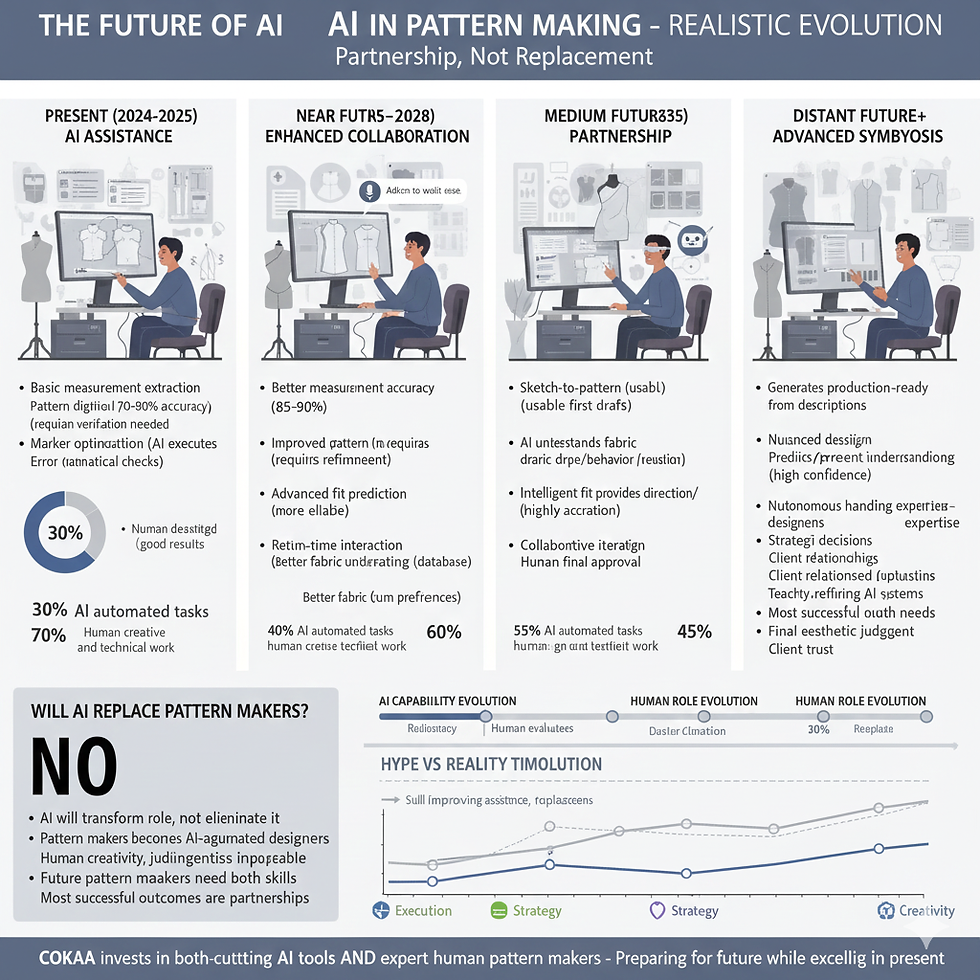
Realistic future outlook based on technology trajectory and industry needs.
Near-Term Evolution (1-3 Years)
Improving Existing Tools:
More accurate measurement extraction
Better pattern digitization
Enhanced grading suggestions
Improved fit prediction
Wider Adoption:
AI tools becoming standard in pattern software
More pattern makers trained in AI assistance
Integration into design and production workflows
Cost reduction making tools accessible to smaller brands
Medium-Term Developments (3-7 Years)
Advanced Capabilities:
Sketch-to-pattern improving substantially
AI understanding fabric properties better
More sophisticated fit prediction
Generative design producing usable patterns
Workflow Integration:
Seamless AI integration across design-to-production pipeline
Real-time collaboration between designers and AI
Automated quality control throughout process
Pattern libraries with AI-powered search and customization
Long-Term Possibilities (7+ Years)
Potential Breakthroughs:
AI understanding design intent from natural language
Virtual AI pattern making assistants
Fully automated routine pattern development
AI-human collaboration achieving superhuman results
Realistic Expectations: Even with major advances, human expertise will remain essential for:
Creative vision and design direction
Complex problem-solving
Quality assessment
Client relationships and consultation
Part 7: Implementing AI in Your Pattern Making Process
Practical guidance for brands considering AI tools.
Assessing Your Needs
Questions to Answer:
What pattern making challenges do we face?
Which tasks are most repetitive or time-consuming?
Where do we struggle with consistency?
What would provide most value: speed, accuracy, or cost reduction?
AI Suitability: AI works best for:
High-volume repetitive work
Standard garment types
Tasks requiring mathematical precision
Pattern optimization and validation
AI less suitable for:
Highly creative custom work
Novel garment types
Complex problem-solving
Brand-specific aesthetic decisions
Choosing AI Tools
Evaluation Criteria:
Actual capabilities vs. marketing claims
Integration with existing systems
Learning curve and training requirements
Cost vs. benefit analysis
Vendor support and updates
Trial and Testing:
Request demonstrations
Test on real projects
Compare AI outputs to manual methods
Assess quality and time savings
Calculate realistic ROI
Hybrid Approach
Best Practice: Combine AI assistance with human expertise:
Use AI for speed on routine tasks
Apply human judgment to AI suggestions
Verify AI outputs before production
Maintain human oversight throughout
COKAA Model: Our custom pattern making service leverages AI where beneficial while ensuring every pattern receives expert human review, refinement, and quality assurance—delivering both efficiency and excellence.
Conclusion: AI as Tool, Not Replacement
Artificial Intelligence is genuinely transforming pattern making—accelerating routine tasks, catching errors, optimizing layouts, and suggesting improvements. These capabilities deliver real value: faster development cycles, more consistent quality, reduced costs, and freed capacity for creative work. AI will continue improving, expanding capabilities and integration depth.
However, AI is not replacing skilled pattern makers. The fashion industry's most successful approach treats AI as a powerful tool augmenting human expertise rather than autonomous replacement. Pattern making requires creativity, technical judgment, contextual understanding, and quality assessment that current (and foreseeable) AI cannot provide.
At COKAA by JR Corporation, 20 years of pattern making expertise informs our AI integration philosophy: embrace beneficial technology while maintaining the human craftsmanship, design sensitivity, and technical mastery that AI cannot replicate. Our clients benefit from AI efficiency combined with expert refinement—patterns developed faster without compromising the quality, accuracy, and design integrity that professional pattern making demands.
The future of pattern making isn't human versus AI—it's humans empowered by AI achieving results neither could accomplish alone. That future is already here for brands choosing pattern making services that thoughtfully integrate technology with irreplaceable expertise.
Ready for pattern making combining AI efficiency with human excellence? Contact COKAA for intelligent pattern services delivering the best of both worlds.

Frequently Asked Questions About AI Pattern Making
Will AI replace pattern makers?
No. AI handles specific tasks well (calculations, optimization, measurement extraction) but cannot replace human creativity, design interpretation, technical judgment, fabric understanding, or quality assessment. AI augments pattern makers' capabilities rather than replacing them entirely.
Are AI-generated patterns production-ready?
Current AI pattern generation produces rough approximations requiring substantial human refinement before production use. AI assists pattern development but doesn't create finished production patterns autonomously.
How accurate is AI pattern grading?
AI grading suggestions are generally mathematically accurate but require human verification ensuring proportions, aesthetics, and fit quality maintain across sizes. AI accelerates grading but skilled pattern makers must validate results.
Can AI understand my design vision?
No. AI cannot interpret creative intent, brand aesthetic, or design philosophy. Pattern makers translate your vision into patterns while AI assists with technical execution.
Is AI pattern making expensive?
Costs vary widely. Some CAD software includes basic AI features at no extra cost. Specialized AI tools range from affordable subscriptions to enterprise licensing. ROI depends on usage volume and application suitability.
Should small brands use AI pattern tools?
Depends on needs. High-volume standard production benefits most. Small-batch custom work sees less benefit. Many small brands get better value partnering with pattern making services that leverage AI on their behalf rather than investing in tools directly.
Comments