Digital Patterns vs Physical Patterns: Which Is Better Garment Patterns Making for Garment Production?
- thecottonkraftco
- Jan 27
- 21 min read

Introduction: The Pattern Format Decision Shaping Garment Production Success
The foundation of successful garment production rests on a critical decision facing every fashion designer, manufacturer, and startup: choosing between digital patterns and physical patterns for garment patterns making. This choice fundamentally impacts production efficiency, cost control, quality consistency, and business scalability—affecting everything from women's formal pant pattern manufacturing to men's blazer pattern production, girls' dress pattern development to boys' shirt pattern execution across your entire fashion operation.
India's ₹3.5 lakh crore fashion industry stands at the intersection of traditional craftsmanship and digital transformation. While physical patterns have served garment pattern making for centuries, digital patterns powered by advanced CAD technology now offer compelling advantages. Yet physical patterns retain relevance in specific production contexts. Understanding which approach—or strategic combination—optimally serves your pattern making service needs determines manufacturing success, competitive positioning, and business growth trajectory.
This comprehensive 3,500-word analysis examines digital patterns versus physical patterns across twelve critical dimensions: accuracy and precision, production efficiency, cost-effectiveness, modification flexibility, storage and organization, scalability potential, grading capabilities, marker making integration, collaboration and sharing, environmental impact, technology requirements, and industry adoption trends. Whether you're a fashion designer seeking pattern making services for fashion designers India, a manufacturer requiring production-ready garment pattern making India, or a startup exploring fashion startup pattern making solutions India, this guide provides actionable intelligence for optimizing your garment patterns making approach.
COKAA, as India's best sewing pattern making service provider and India's 1st online sewing pattern provider, delivers both digital and physical patterns serving diverse production needs. Our accurate digital sewing pattern making service India and traditional physical pattern options ensure your fashion journey with our patterns succeeds regardless of manufacturing infrastructure, technology adoption, or production scale.
1. Accuracy and Precision: The Foundation of Quality
Garment Patterns Making
Pattern accuracy determines garment fit, production efficiency, and customer satisfaction—making precision the primary consideration in garment patterns making.
Digital Pattern Precision: Mathematical Perfection
CAD Technology Accuracy:
Digital patterns created through 2D and 3D garment pattern making India deliver superior precision:
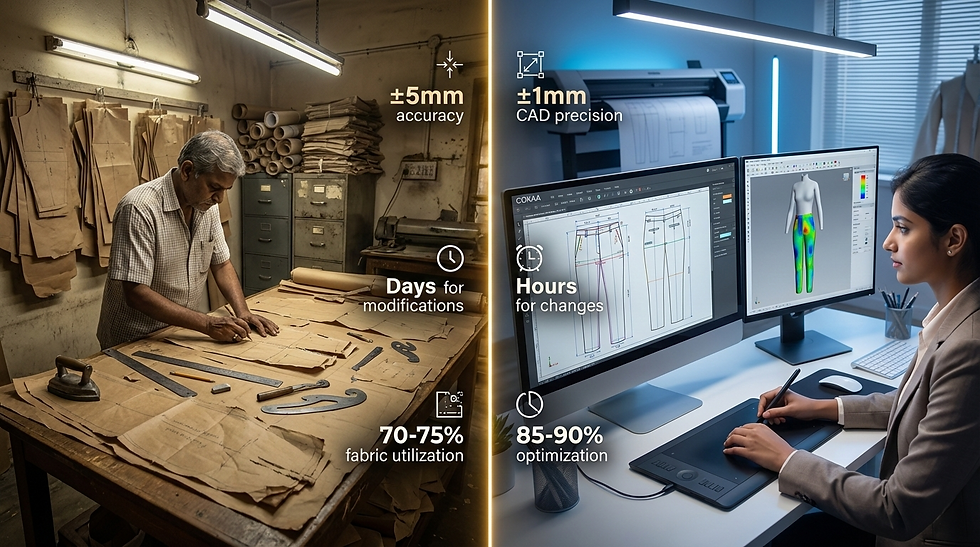
±1mm CAD Accuracy: Computer-generated women's dress patterns, men's shirt patterns achieve mathematical precision impossible with hand drafting—curves perfectly smooth, lines exactly straight, measurements precisely calculated to decimal points.
Automated Symmetry: Digital CAD pattern making services India ensure women's formal pant patterns, girls' dress patterns have perfectly matched left/right sides—eliminating human error creating twisted garments, asymmetric fits compromising quality.
Pattern Piece Matching: Digital verification confirms women's jacket pattern armholes match sleeve caps exactly, men's blazer pattern collar matches neckline precisely—preventing assembly problems discovered only during production with physical patterns.
Measurement Consistency: Every women's legging pattern, boys' pants pattern maintains exact specified dimensions—no variation between pattern copies, no degradation over time, ensuring consistent production quality.
Curve Quality: Mathematical algorithms create flawlessly smooth curves in women's flared skirt patterns, men's pant patterns—superior to hand-drawn curves with bumps and irregularities causing fit problems, fabric waste, sewing difficulties.
Physical Pattern Precision: Traditional Limitations
Hand Drafting Accuracy:
Physical patterns created through traditional methods face inherent precision challenges:
±5mm Tolerance: Hand-drafted women's kurta patterns, men's formal pant patterns typically achieve only ±5mm accuracy—five times less precise than digital patterns, creating fit inconsistencies, quality variations.
Symmetry Challenges: Manually ensuring women's top pattern left side matches right side exactly proves difficult—minor asymmetries accumulate causing garment twist, uneven hemlines, fit problems.
Degradation Over Time: Physical patterns for women's nightwear patterns, boys' shirt patterns wear with use—edges fray, paper tears, markings fade, requiring periodic pattern replacement or risking production quality decline.
Copying Errors: Creating duplicate physical patterns for women's crop top patterns, men's hoodie patterns introduces tracing errors—each copy potentially less accurate than original, quality degrading through pattern generations.
Human Error Factor: Traditional pattern making service relying on manual drafting for women's co-ord set patterns, men's sweatshirt patterns remains vulnerable to calculation mistakes, measurement errors, drafting inconsistencies affecting production.
Precision Impact on Production
Quality Consequences:
Pattern accuracy differences directly affect garment production outcomes:
Fit Consistency: Digital pattern precision ensures women's formal pant patterns, men's blazer patterns produce identical fits across production runs—physical pattern variations create fit inconsistencies causing customer complaints, returns.
Production Efficiency: Accurate digital patterns for women's jacket patterns, boys' pants patterns reduce fitting adjustments, rework, and quality rejections—physical pattern imprecision increases production time, labor costs.
Professional Reputation: Consistent fits from digital women's dress patterns, men's shirt patterns build brand reputation—physical pattern variability creates unpredictable quality damaging brand image.
2. Production Efficiency: Speed and Workflow Integration
Pattern format significantly impacts production timelines, workflow efficiency, and manufacturing capability—critical factors for competitive garment patterns making.
Digital Pattern Production Advantages
Manufacturing Integration:
Digital patterns seamlessly integrate with modern production systems:
Automated Cutting Systems: DXF format women's legging patterns, men's pant patterns directly interface with computerized cutting machines—eliminating manual pattern laying, reducing cutting time 60-70%, improving fabric utilization, ensuring cutting accuracy.
CAD/CAM Integration: Digital women's top patterns, men's t-shirt patterns integrate with computer-aided manufacturing systems—streamlined workflow from design to production without physical pattern intermediaries.
Instant Distribution: Cloud delivery of digital women's kurta patterns, girls' dress patterns to multiple production facilities simultaneously—no shipping delays, enabling distributed manufacturing, rapid production scaling.
Rapid Modifications: Design changes to digital women's crop top patterns, men's hoodie patterns implemented in hours—updated patterns instantly distributed to all production locations without physical pattern regeneration, shipping.
Virtual Sampling: Virtual sampling and pattern design India capabilities preview digital women's jacket patterns, men's blazer patterns on 3D dress forms before physical samples—identifying fit issues early, reducing sampling cycles 40-60%.
Physical Pattern Production Limitations
Traditional Workflow Constraints:
Physical patterns face inherent production efficiency challenges:
Manual Pattern Laying: Workers physically arrange women's formal pant patterns, boys' shirt patterns on fabric—time-consuming process taking hours for complex layouts, requiring skilled labor, prone to human error.
Pattern Transportation: Shipping physical women's nightwear patterns, men's semi formal pant patterns to production facilities takes days—delays production starts, complicates multi-location manufacturing, increases logistics costs.
Pattern Preparation Time: Cutting, tracing, and preparing physical women's dress patterns, men's shirt patterns for production requires significant setup time—digital patterns ready instantly.
Limited Scalability: Physical pattern availability limits simultaneous production—multiple cutting tables need duplicate physical patterns while digital patterns support unlimited concurrent use.
Modification Delays: Changes to physical women's skirt patterns, boys' pants patterns require remaking patterns, redistributing to facilities—process taking days or weeks versus hours with digital patterns.
Efficiency Impact on Business
Competitive Advantages:
Production efficiency differences create measurable business advantages:
Time-to-Market: Digital pattern making service reduces product development timelines 30-40%—faster market entry, better trend response, competitive advantage for women's co-ord set patterns, men's oversized t-shirt patterns.
Production Capacity: Automated cutting with digital patterns increases daily production capacity 50-70%—more garments manufactured with same resources using women's formal pant patterns, girls' top patterns.
Operational Costs: Streamlined digital workflow reduces labor requirements for pattern management—cost savings enabling competitive pricing for women's legging patterns, men's pant patterns production.
3. Cost-Effectiveness: Initial Investment and Long-Term Value
Understanding total cost of ownership for digital versus physical garment patterns making reveals significant financial implications.
Digital Pattern Cost Analysis
Investment and ROI:
Digital pattern making service requires technology investment but delivers substantial long-term savings:
Initial Costs: Professional digital CAD pattern making services India: ₹2,000-8,000 per custom women's jacket pattern, men's formal pant pattern—higher than physical pattern alternatives initially.
Technology Requirements: CAD software, computers, plotters for in-house digital pattern creation: ₹2-5 lakhs initial investment—significant barrier for small operations but economical for established manufacturers.
Online Sewing Pattern Access: Ready-made digital patterns from India's 1st online sewing pattern provider: ₹500-3,500 for women's top patterns, men's shirt patterns—affordable immediate access without infrastructure investment.
Long-Term Savings: Digital patterns never wear out—one-time creation cost for women's dress patterns, boys' t-shirt patterns serves unlimited production runs without replacement, maintenance, or degradation costs.
Modification Economics: Pattern changes to digital women's kurta patterns, men's hoodie patterns cost ₹500-2,000—versus ₹3,000-6,000 recreating physical patterns, significant savings over product lifecycle.
Storage Costs: Digital pattern libraries for women's nightwear patterns, girls' dress patterns require only cloud storage: ₹100-500 monthly—versus physical storage space costing thousands monthly.
Physical Pattern Cost Analysis
Traditional Cost Structure:
Physical pattern making service presents different cost dynamics:
Pattern Creation: Custom physical women's formal pant patterns, men's blazer patterns: ₹1,500-6,000—lower initial cost than digital alternatives attractive to budget-conscious startups.
No Technology Barrier: Physical patterns require no computer systems, software licenses, or technical infrastructure—accessible to traditional manufacturers, small workshops with limited technology adoption.
Replacement Costs: Physical women's legging patterns, boys' pants patterns degrade requiring replacement every 20-50 production runs—ongoing costs accumulating over time exceeding digital pattern investment.
Storage Expenses: Physical storage for women's co-ord set patterns, men's sweatshirt patterns collections requires dedicated space—monthly rent, climate control, organization systems adding significant overhead.
Duplication Costs: Creating multiple physical pattern sets for women's crop top patterns, men's t-shirt patterns production: ₹300-1,000 per set—necessary for multi-table operations, distributed manufacturing.
Shipping Expenses: Transporting physical women's jacket patterns, boys' shirt patterns between locations: ₹200-1,500 per shipment—recurring costs for multi-facility operations, pattern sharing.
Cost-Effectiveness Verdict
Financial Optimization:
Cost analysis reveals optimal approaches for different production scales:
Startups and Small Batches: Ready-made digital patterns from affordable garment CAD pattern making service offer best value—₹500-3,500 patterns enabling professional production without major investment for women's dress patterns, men's pant patterns testing.
Medium Production: Custom digital patterns provide superior ROI—initial investment quickly recovered through elimination of replacement, storage, duplication costs for women's formal pant patterns, girls' dress patterns manufacturing.
Large-Scale Manufacturing: Digital pattern infrastructure essential—automation savings, efficiency gains, quality consistency justify technology investment for high-volume women's top patterns, men's shirt patterns production.
Traditional Small Workshops: Physical patterns remain economically viable—limited production volumes, existing manual workflows, low technology adoption making physical women's kurta patterns, boys' pants patterns appropriate.
4. Modification Flexibility and Design Iteration
Pattern adaptability for design changes, fit refinements, and style variations significantly impacts fashion development efficiency.
Digital Pattern Modification Advantages
Rapid Design Iteration:
Digital patterns enable agile design development:
Quick Adjustments: Modifying digital women's formal pant patterns, men's blazer patterns takes hours—lengthening, widening, style line changes, seam allowance adjustments implemented rapidly in CAD systems.
Non-Destructive Editing: Original digital women's dress patterns, boys' shirt patterns preserved while creating variations—experimentation without losing proven base patterns, enabling design exploration.
Parametric Modifications: Changing one dimension in digital women's legging patterns, men's pant patterns automatically updates all related measurements—proportional adjustments maintaining pattern integrity without manual recalculation.
Version Control: Digital pattern making service maintains complete history of women's jacket pattern, men's hoodie pattern modifications—reverting to previous versions, tracking design evolution, documenting development process.
Style Variations: Creating multiple versions of digital women's top patterns, girls' dress patterns (different sleeve lengths, necklines, hem shapes) quick and economical—physical patterns require complete redrafting for each variation.
Physical Pattern Modification Limitations
Change Management Challenges:
Physical patterns face significant modification constraints:
Time-Consuming Changes: Altering physical women's kurta patterns, men's formal pant patterns requires remaking affected pattern pieces—process taking days versus hours with digital patterns.
Destructive Modifications: Cutting, adjusting physical women's nightwear patterns, boys' pants patterns destroys original—no reverting if changes unsuccessful, requiring pattern recreation from backup copies if maintained.
Limited Experimentation: Modification difficulty discourages design exploration with physical women's crop top patterns, men's sweatshirt patterns—settling for acceptable rather than optimal designs due to revision burden.
Manual Recalculation: Changing physical women's flared skirt patterns, men's semi formal pant patterns requires manual recalculation of all affected dimensions—time-consuming, error-prone process.
Version Confusion: Managing multiple physical pattern versions for women's co-ord set patterns, men's t-shirt patterns creates organization challenges—difficulty identifying latest revision, tracking changes, maintaining pattern history.
Flexibility Impact on Fashion Development
Design Process Enhancement:
Modification capability differences affect fashion development quality:
Design Refinement: Digital pattern flexibility enables perfecting women's formal pant fit, men's blazer construction through multiple iterations—physical pattern modification burden often results in accepting imperfect designs.
Market Response: Rapid digital pattern adjustments for women's jacket patterns, girls' dress patterns enable quick response to buyer feedback, retail requirements, trend changes—physical pattern inflexibility slows market adaptation.
Customization Capability: Made-to-order services using digital women's dress patterns, men's slim fit shirt patterns easily accommodate individual measurements—physical pattern customization labor-intensive and economically challenging.
5. Pattern Grading and Size Range Development
Comprehensive sizing critically impacts market reach, customer satisfaction, and sales potential in garment patterns making.
Digital Pattern Grading Excellence
Automated Size Development:
Digital pattern grading and marker making services India deliver superior size range creation:
Proportional Accuracy: Automated grading of digital women's formal pant patterns, men's shirt patterns maintains design proportions, fit intent across XS-5XL—physical patterns often lose fit quality in extreme sizes through manual grading errors.
Grade Rule Consistency: Digital systems apply identical grading rules throughout women's legging patterns, boys' pants patterns—ensuring every pattern piece grades consistently, maintaining garment balance all sizes.
Rapid Size Range Creation: Grading digital women's dress patterns, men's hoodie patterns across 8-10 sizes takes hours—versus days or weeks manually grading physical patterns for each size.
Grade Verification: CAD systems mathematically verify grade accuracy in women's jacket patterns, girls' dress patterns—catching grading errors before production while physical pattern grading errors discovered only through sampling or customer complaints.
Custom Size Development: Digital pattern grading easily creates brand-specific size standards for women's kurta patterns, men's pant patterns—physical pattern custom grading labor-intensive and expensive.
Plus-Size Engineering: Digital grading properly handles plus-size women's top patterns, men's sweatshirt patterns with appropriate proportional adjustments—physical pattern plus-size grading often inadequate creating poor fits.
Physical Pattern Grading Limitations
Manual Grading Challenges:
Traditional grading of physical patterns faces significant obstacles:
Time-Intensive Process: Manually grading physical women's nightwear patterns, boys' shirt patterns across size range requires days per style—significant time investment limiting style development capacity.
Grading Accuracy Issues: Human calculation errors in physical women's co-ord set patterns, men's semi formal pant patterns grading create fit problems in specific sizes—expensive corrections requiring pattern remakes, production delays.
Limited Size Ranges: Manual grading difficulty often limits physical patterns to standard 4-6 sizes for women's crop top patterns, men's t-shirt patterns—missing market opportunities in petite, tall, plus-size segments.
Grade Checking Difficulty: Verifying physical pattern grading accuracy for women's flared skirt patterns, boys' pants patterns requires extensive manual measurement—time-consuming process often abbreviated compromising quality.
Modification Complications: Changes to base physical women's formal pant pattern, men's blazer pattern require regrading entire size range—compounding modification time and cost burdens.
Grading Impact on Market Success
Size Range Advantages:
Grading capability differences affect market reach and competitive positioning:
Inclusive Sizing: Digital pattern making service easily creates XS-5XL ranges for women's dress patterns, men's pant patterns—serving broader customer base, demonstrating inclusivity, expanding sales potential.
Fit Consistency: Accurate digital grading ensures women's jacket patterns, girls' top patterns fit correctly across all sizes—customer satisfaction, reduced returns, positive reviews building brand reputation.
Development Speed: Rapid digital grading enables larger seasonal collections of women's legging patterns, men's hoodie patterns—more style options competing effectively in fast fashion markets.
Cost Efficiency: Automated digital grading reduces per-style development costs for women's kurta patterns, boys' t-shirt patterns—economically enabling broader product ranges.
6. Marker Making and Fabric Utilization Optimization
Efficient marker making significantly impacts production costs through fabric waste reduction—a critical factor in profitable garment patterns making.
Digital Marker Making Superiority
Computerized Nesting Optimization:
Digital marker making maximizes fabric utilization:
Optimal Nesting: Computer algorithms arrange digital women's top patterns, men's shirt patterns achieving 85-90% fabric utilization—versus 70-75% with manual physical pattern marking, reducing waste 15-20% directly improving profit margins.
Rapid Marker Creation: Digital marker making for women's formal pant patterns, boys' pants patterns takes hours—versus days manually arranging physical patterns, accelerating production preparation.
Multi-Size Markers: Digital systems optimize production-ratio markers (2 Small, 3 Medium, 3 Large, 2 XL) for women's dress patterns, men's pant patterns—balancing fabric efficiency with actual order distributions.
Pattern Matching: Digital markers for women's flared skirt patterns in plaids, men's shirt patterns in stripes automatically account for pattern matching requirements—maintaining design integrity while optimizing utilization.
Marker Variations: Creating multiple digital markers testing different fabric widths, layouts for women's jacket patterns, men's blazer patterns economically explores optimization strategies—physical marker remakes expensive and time-consuming.
Cost Calculation: Digital marker making instantly calculates fabric requirements for women's legging patterns, girls' dress patterns—accurate costing, material planning, waste prediction before cutting begins.
Physical Marker Making Limitations
Manual Nesting Constraints:
Traditional marker making with physical patterns faces efficiency challenges:
Lower Utilization: Manual arrangement of physical women's nightwear patterns, boys' shirt patterns typically achieves only 70-75% fabric utilization—15-20% fabric waste costing ₹50-100 per garment over product lifecycle.
Time-Consuming Process: Creating physical markers for women's co-ord set patterns, men's sweatshirt patterns takes days—skilled marker makers manually arranging patterns, measuring utilization, adjusting layouts through trial-and-error.
Limited Optimization: Physical marker making explores fewer layout variations for women's crop top patterns, men's hoodie patterns—time constraints preventing thorough optimization leaving efficiency gains unexploited.
Pattern Matching Challenges: Accounting for fabric pattern matching with physical women's kurta patterns, men's formal pant patterns requires significant additional time and expertise—often compromised due to difficulty.
Calculation Burden: Manual calculation of fabric requirements from physical markers for women's formal pant patterns, girls' top patterns prone to errors—costing mistakes, material shortages, excess inventory.
Marker Making Impact on Profitability
Fabric Efficiency Economics:
Marker making quality directly affects bottom line:
Material Cost Savings: 15-20% waste reduction through digital marker making for women's dress patterns, men's pant patterns saves ₹50-100 per garment—accumulating to lakhs in savings over production volumes.
Competitive Pricing: Lower material costs from optimized digital markers for women's jacket patterns, boys' pants patterns enable more competitive retail pricing or higher profit margins.
Sustainability Impact: Reduced fabric waste through digital marker making for women's legging patterns, men's t-shirt patterns supports environmental sustainability goals—appealing to eco-conscious consumers, meeting regulatory requirements.
7. Storage, Organization, and Pattern Management
Pattern library management significantly impacts operational efficiency, pattern accessibility, and long-term cost of ownership in garment patterns making.
Digital Pattern Storage Advantages
Cloud-Based Pattern Libraries:
Digital patterns offer superior storage and organization:
Zero Physical Space: Digital libraries storing thousands of women's dress patterns, men's shirt patterns, girls' dress patterns, boys' pants patterns require no physical storage space—eliminating monthly rent, climate control, organization costs.
Unlimited Capacity: Cloud storage easily accommodates growing pattern collections of women's formal pant patterns, men's blazer patterns without facility expansion—scalable storage matching business growth.
Instant Search and Retrieval: Finding specific digital women's jacket pattern, men's hoodie pattern takes seconds—keyword search, style number lookup, date filtering versus hours searching physical pattern archives.
Perfect Preservation: Digital women's kurta patterns, boys' shirt patterns never degrade—stored patterns maintain original quality indefinitely without wear, tear, fading, or damage affecting physical patterns.
Version Control: Digital pattern making service automatically tracks all modifications to women's top patterns, men's pant patterns—complete revision history, ability to revert to any previous version without maintaining multiple physical copies.
Backup Protection: Cloud-backed digital women's nightwear patterns, girls' top patterns protected from loss through fire, flood, theft—physical pattern destruction permanently loses pattern investment.
Remote Access: Digital women's crop top patterns, men's sweatshirt patterns accessible from anywhere with internet—supporting distributed teams, remote work, multi-location manufacturing without pattern transportation.
Physical Pattern Storage Challenges
Space and Organization Requirements:
Physical patterns demand substantial storage infrastructure:
Storage Space Costs: Dedicated physical storage for women's formal pant patterns, men's semi formal pant patterns, complete collections requires significant square footage—monthly facility costs, climate control expenses adding operational overhead.
Organization Systems: Managing physical women's co-ord set patterns, boys' co-ord set patterns collections requires filing systems, labeling schemes, inventory management—labor-intensive maintenance preventing pattern loss, mix-ups.
Pattern Degradation: Physical women's legging patterns, men's t-shirt patterns deteriorate over time—edges fray, paper tears, markings fade requiring pattern replacement even if design unchanged.
Limited Accessibility: Physical patterns accessible only at storage location—supporting multi-location manufacturing requires duplicate pattern sets or shipping delays affecting production scheduling.
Disaster Vulnerability: Fire, flood, or theft destroys physical women's dress patterns, boys' pants patterns—losing pattern investment, product development history, manufacturing capability without backup systems.
Search Difficulty: Locating specific physical women's jacket pattern, men's formal pant pattern in large collections takes considerable time—inefficient retrieval slowing production preparation, pattern modification workflows.
Storage Impact on Operations
Management Efficiency:
Pattern storage and organization methods affect daily operational efficiency:
Operational Costs: Digital pattern storage savings of ₹10,000-50,000 monthly in facility costs, labor for women's kurta pattern, men's shirt pattern collections enable investment in other business areas.
Production Speed: Instant digital pattern retrieval for women's formal pant patterns, girls' dress patterns accelerates production preparation—physical pattern searching delays production starts affecting delivery timelines.
Business Continuity: Cloud-backed digital women's top patterns, men's pant patterns ensure business continuity after disasters—physical pattern loss can permanently damage manufacturing capability.
8. Collaboration and Pattern Sharing
Modern fashion development often involves distributed teams, outsourced production, and global collaboration—making pattern sharing capabilities increasingly important.
Digital Pattern Collaboration Excellence
Seamless Remote Collaboration:
Digital patterns enable efficient distributed fashion development:
Instant Distribution: Digital women's jacket patterns, men's blazer patterns shared instantly via email, cloud links to pattern makers, sample makers, manufacturers worldwide—no shipping delays, enabling global collaboration.
Simultaneous Access: Multiple team members accessing same digital women's dress patterns, boys' shirt patterns concurrently—designers reviewing, pattern makers modifying, production planning simultaneously without pattern availability conflicts.
Remote Consultation: Fashion designers consulting pattern making services for fashion designers India share digital women's kurta patterns, men's hoodie patterns for remote review, feedback, technical assistance—geographic barriers eliminated.
Version Synchronization: Cloud-based digital patterns ensure everyone works with latest version of women's formal pant patterns, girls' dress patterns—preventing production errors from outdated pattern usage.
Supplier Integration: Digital women's legging patterns, men's pant patterns easily shared with fabric suppliers, trimmings vendors, sampling services—coordinated development without physical material exchanges.
Physical Pattern Sharing Limitations
Collaboration Constraints:
Physical patterns face significant sharing challenges:
Shipping Delays: Sending physical women's nightwear patterns, boys' pants patterns to remote manufacturers takes days—slowing production starts, complicating international outsourcing, affecting delivery commitments.
Single Access Point: Only one location uses physical women's crop top patterns, men's sweatshirt patterns at a time—parallel development work requiring duplicate sets, duplication costs, synchronization challenges.
Duplication Costs: Creating physical copies for distributed teams working on women's co-ord set patterns, men's semi formal pant patterns: ₹300-1,000 per set—recurring expenses for collaborative projects.
Version Control Difficulty: Ensuring all locations have current physical women's formal pant pattern, men's t-shirt pattern version challenging—production errors from outdated patterns, change management complications.
Communication Barriers: Discussing physical women's flared skirt patterns, boys' shirt patterns modifications requires detailed verbal descriptions, sketches, photographs—digital patterns easily annotated, marked, visually communicated.
Collaboration Impact on Development
Team Efficiency:
Pattern sharing capability affects fashion development workflows:
Development Speed: Instant digital pattern sharing for women's dress patterns, men's pant patterns accelerates development cycles 30-40%—faster sampling, quicker production starts, better market responsiveness.
Global Sourcing: Digital women's jacket patterns, girls' top patterns enable cost-effective international manufacturing—physical pattern shipping costs, delays making global outsourcing less attractive.
Distributed Teams: Remote pattern making service India using digital women's kurta patterns, men's shirt patterns supports distributed fashion teams—talent access regardless of location, operational flexibility.
9. Technology Requirements and Adoption Barriers
Understanding technology infrastructure needs and skill requirements helps fashion businesses make informed pattern format decisions.
Digital Pattern Technology Needs
Infrastructure and Skills:
Adopting digital garment patterns making requires specific capabilities:
Software Requirements: Professional CAD systems for 2D and 3D garment pattern making India: ₹50,000-300,000 annually—significant investment for small businesses, startups exploring pattern making service options.
Hardware Needs: Computers capable of running pattern software, large-format plotters for printing digital patterns: ₹2-5 lakhs—technology barrier for traditional manufacturers with limited capital.
Technical Skills: Staff trained in digital pattern making service, CAD software operation, digital workflow management—skill development time, training costs, learning curve affecting short-term productivity.
Internet Dependency: Cloud-based digital pattern access requires reliable internet connectivity—challenging in some manufacturing areas, potential workflow disruption during connectivity issues.
File Management: Digital women's formal pant patterns, men's blazer patterns require organized file systems, backup procedures, version control—new processes compared to familiar physical pattern management.
Format Compatibility: Ensuring digital women's dress patterns, boys' shirt patterns compatible across different CAD systems, cutting equipment—technical coordination between software platforms.
Physical Pattern Accessibility
Low Technology Barriers:
Physical patterns remain accessible to traditional operations:
No Software Required: Creating, using physical women's kurta patterns, men's formal pant patterns needs no computer systems, software licenses, or technical infrastructure—accessible to all manufacturing scales.
Familiar Skills: Traditional pattern makers possess physical pattern drafting, modification, management skills—no retraining required, no productivity loss during skill development.
No Connectivity Dependency: Physical women's top patterns, men's pant patterns usable anywhere regardless of internet access, electricity availability, technology infrastructure—reliable in all manufacturing environments.
Simple Management: Physical pattern organization using familiar filing systems, visual identification, hands-on access—no digital file management, backup procedures, format compatibility concerns.
Immediate Usability: Physical women's jacket patterns, girls' dress patterns ready for production immediately—no learning curve, no software operation, no technical troubleshooting.
Adoption Considerations
Technology Transition Strategies:
Navigating digital pattern adoption successfully:
Hybrid Approach: Many successful operations use both digital and physical patterns—digital women's formal pant patterns, men's shirt patterns for new development, physical patterns for proven production styles, gradually transitioning inventory.
Service Provider Option: Using professional pattern making services India like COKAA avoids technology investment—accessing digital CAD pattern making services India benefits without infrastructure costs for women's legging patterns, boys' pants patterns projects.
Ready-Made Digital Patterns: India's 1st online sewing pattern provider offers ready-made digital patterns—experiencing digital pattern benefits without CAD software investment for women's crop top patterns, men's hoodie patterns.
Gradual Implementation: Starting digital adoption with high-volume women's nightwear patterns, men's t-shirt patterns demonstrating ROI before expanding—reducing financial risk, managing change effectively.
10. Environmental Impact and Sustainability
Sustainability increasingly influences business decisions, customer preferences, and regulatory compliance in fashion industry—making environmental considerations relevant to garment patterns making choices.
Digital Pattern Environmental Benefits
Reduced Resource Consumption:
Digital patterns support sustainable fashion practices:
Paper Elimination: Digital women's dress patterns, men's pant patterns eliminate paper consumption—physical patterns consuming significant paper for pattern pieces, duplicates, replacements throughout lifecycle.
Shipping Reduction: Digital distribution of women's formal pant patterns, boys' shirt patterns eliminates transportation emissions—physical pattern shipping contributing to carbon footprint multiple times per pattern lifetime.
Waste Minimization: Optimized digital marker making for women's jacket patterns, men's blazer patterns reduces fabric waste 15-20%—fewer textiles in landfills, reduced environmental impact per garment produced.
Space Efficiency: Digital storage eliminating physical facility needs for women's kurta pattern, men's shirt pattern libraries reduces building footprint, climate control energy consumption, associated environmental costs.
Longevity Without Replacement: Digital women's top patterns, men's hoodie patterns never degrade—no replacement waste from worn physical patterns requiring disposal and recreation.
Physical Pattern Environmental Impact
Resource-Intensive Nature:
Physical patterns carry higher environmental costs:
Paper Consumption: Physical women's nightwear patterns, boys' pants patterns consume substantial paper—pattern pieces, duplicates, replacements over pattern lifetime creating significant paper waste.
Transportation Emissions: Shipping physical women's co-ord set patterns, men's sweatshirt patterns between locations generates carbon emissions—potentially multiple shipments per pattern during development, production lifecycle.
Storage Energy Use: Climate-controlled storage for physical women's formal pant patterns, girls' dress patterns consumes continuous energy—monthly environmental cost throughout pattern retention period.
Material Waste: Less efficient physical marker making for women's crop top patterns, men's semi formal pant patterns increases fabric waste—greater environmental impact per garment manufactured.
Disposal Impact: Discarding worn physical women's legging patterns, men's t-shirt patterns adds to waste stream—paper, cardboard contributing to landfill volumes.
Sustainability Alignment
Environmental Positioning:
Pattern format choice affects sustainability credentials:
Green Brand Positioning: Digital pattern adoption for women's jacket patterns, boys' shirt patterns demonstrates environmental commitment—appealing to eco-conscious consumers, supporting sustainability marketing.
Regulatory Compliance: Waste reduction through digital women's formal pant patterns, men's pant patterns helps meet increasingly stringent environmental regulations affecting fashion manufacturing.
Corporate Responsibility: Digital pattern making service aligns with corporate sustainability goals—measurable environmental impact reduction from women's dress pattern, girls' top pattern operations.
11. Industry Adoption Trends and Future Direction
Understanding current adoption patterns and future trajectory helps fashion businesses make forward-looking pattern format decisions.
Growing Digital Pattern Adoption
Industry Digital Transformation:
Fashion industry increasingly embraces digital garment patterns making:
Major Brand Leadership: Global fashion brands standardizing on digital women's formal pant patterns, men's blazer patterns—driving supplier adoption, establishing industry expectations, validating digital approach.
Export Requirements: International buyers increasingly requiring digital women's jacket patterns, boys' shirt patterns—digital capability becoming competitive necessity for export-focused manufacturers.
Automation Integration: Industry 4.0 initiatives demanding digital women's dress patterns, men's shirt patterns—connecting design, pattern making, marker making, cutting, sewing through digital infrastructure.
Technology Advancement: Improving CAD software, declining technology costs, better internet connectivity making digital women's kurta patterns, men's pant patterns increasingly accessible to smaller operations.
Skill Development: Growing availability of trained pattern makers familiar with digital women's top patterns, men's hoodie patterns—reducing technology adoption barrier, enabling transition.
Startup Adoption: New fashion businesses launching with digital-first approach—using online sewing pattern services, digital CAD pattern making services India for women's crop top patterns, men's sweatshirt patterns development.
Physical Pattern Persistence
Continued Physical Pattern Relevance:
Physical patterns retain role in specific contexts:
Traditional Manufacturers: Small workshops, traditional tailors, artisan operations continuing physical women's nightwear patterns, boys' pants patterns—familiar methods, established workflows, low technology adoption.
Limited Production Runs: Very small batches, one-off garments using physical women's co-ord set patterns, men's semi formal pant patterns—digital investment not justified for minimal production volumes.
Hands-On Preference: Some experienced pattern makers preferring physical pattern tactile feedback for women's formal pant patterns, girls' dress patterns—skill translation from decades physical pattern experience.
Technology Limitations: Operations in areas with poor internet connectivity, unreliable electricity continuing physical women's flared skirt patterns, men's t-shirt patterns—infrastructure constraints preventing digital adoption.
Future Trajectory
Industry Direction:
Pattern format evolution continuing toward digital dominance:
Hybrid Standard:
Most operations moving toward hybrid approach—digital women's jacket patterns, men's pant patterns for development and production, physical patterns as backup or specialty applications.
Digital Acceleration: Technology improvements, cost reductions, skill availability accelerating digital adoption for women's legging patterns, boys' shirt patterns across all manufacturing scales.
Innovation Enabling: Digital patterns essential for emerging technologies—3D virtual sampling, AI-powered design, automated manufacturing requiring digital women's dress patterns, men's hoodie patterns foundation.
12. The Verdict: Choosing the Right Approach for Your Garment Patterns Making
Comprehensive analysis reveals optimal pattern format choices depend on specific business context, production requirements, and growth trajectory.
Digital Patterns Excel For:
Modern Production Environments:
Medium to Large Manufacturers: Production volumes justifying technology investment, operations benefiting from automation, efficiency gains with digital women's formal pant patterns, men's shirt patterns
Export-Focused Businesses: International buyers requiring digital patterns, global supply chain integration, distributed manufacturing coordination for women's dress patterns, boys' pants patterns
Growth-Oriented Fashion Brands: Businesses scaling production, expanding style ranges, requiring rapid development cycles using digital women's jacket patterns, men's blazer patterns
Technology-Enabled Operations: Manufacturers with automated cutting systems, CAD/CAM infrastructure, digital workflow integration for women's kurta patterns, men's pant patterns
Remote Collaboration: Distributed teams, outsourced production, global partnerships requiring instant pattern sharing for women's top patterns, girls' dress patterns
Sustainability Focus: Brands prioritizing environmental responsibility, waste reduction, green credentials through digital women's legging patterns, men's hoodie patterns
Physical Patterns Remain Appropriate For:
Traditional and Small-Scale Operations:
Small Workshops: Limited production volumes, minimal technology infrastructure, traditional skills focus using physical women's nightwear patterns, boys' shirt patterns
Artisan Production: Bespoke tailoring, custom garments, handcrafted manufacturing maintaining traditional methods with physical women's co-ord set patterns, men's semi formal pant patterns
Test and Sample: Initial prototyping, design exploration, small batch trials before digital pattern investment for women's crop top patterns, men's sweatshirt patterns
Technology Limitations: Operations in areas with poor connectivity, limited electricity, infrastructure challenges requiring physical women's formal pant patterns, girls' top patterns
Backup Systems: Disaster recovery, technology failure contingency maintaining physical copies of critical women's jacket patterns, men's t-shirt patterns
Hybrid Approach: Optimal for Most
Balanced Strategy:
Many successful operations benefit from combining both formats:
Digital for Development: New women's dress patterns, men's pant patterns created digitally—precision, modification flexibility, grading efficiency, digital advantages for development phase
Physical for Production: Proven patterns converted to physical for cutting table use—familiar workflow, hands-on management, no technology dependency during manufacturing
Service Provider Partnership: Professional pattern making services India like COKAA providing digital patterns, physical pattern printing, both format delivery—accessing digital advantages without infrastructure investment
Gradual Transition: Starting with high-volume women's formal pant patterns, men's shirt patterns digitally, maintaining physical patterns for established styles, progressive digital adoption
Conclusion: Making the Right Garment Patterns Making Decision
The digital patterns versus physical patterns decision fundamentally impacts garment production efficiency, cost management, quality consistency, and business competitiveness. Digital patterns deliver superior accuracy (±1mm CAD precision), production efficiency (60-70% cutting time reduction), cost-effectiveness (one-time investment serving unlimited production), modification flexibility (hours versus days for changes), comprehensive grading (accurate XS-5XL ranges), optimized marker making (85-90% fabric utilization), unlimited storage (zero physical space costs), seamless collaboration (instant worldwide distribution), environmental benefits (paper elimination, waste reduction), and alignment with industry digital transformation trends.
Physical patterns retain relevance for traditional manufacturers, small-scale operations, limited technology infrastructure, artisan production, and backup applications—offering accessibility without technology barriers, familiar workflows, hands-on management, and suitability for very limited production volumes.
For most fashion businesses, the optimal approach involves accessing digital pattern benefits through professional pattern making services India, ready-made online sewing patterns, or strategic technology investment for in-house digital CAD pattern making capability—while potentially maintaining physical patterns for proven production styles, backup contingency, or traditional workflow integration.
COKAA, as India's best sewing pattern making service provider, top garment pattern making service provider India, and India's 1st online sewing pattern provider, delivers comprehensive solutions: accurate digital sewing pattern making service India with ±1mm CAD precision, production-ready garment pattern making India with complete technical specifications, professional pattern grading and marker making services India optimizing size ranges and fabric utilization, virtual sampling and pattern design India reducing development costs, physical pattern printing and shipping supporting traditional manufacturing, and affordable garment CAD pattern making service accessible to fashion startups and established manufacturers equally.
Whether you need digital women's formal pant patterns for automated cutting systems, physical men's blazer patterns for traditional production tables, comprehensive women's dress patterns collections across all sizes, made-to-order patterns for custom garments, or complete fashion startup pattern making solutions India—your fashion journey with our patterns succeeds through optimal garment patterns making approaches matched to your specific production requirements, business scale, and growth ambitions.
Partner with India's leading pattern making & grading service provider. Visit COKAA.in for professional digital and physical pattern solutions, expert consultation, comprehensive garment pattern making support, and proven results optimizing your garment production from sketch to sample across all categories. Transform your pattern making service experience with production-ready quality, technical precision, and format flexibility enabling manufacturing success.
Comments