Custom Pattern Making Services: What to Expect from Professional Bespoke Patterns
- thecottonkraftco
- Jan 8
- 13 min read


Why Custom Pattern Making Services Transform Your Fashion Business
The fashion industry generates over $1.5 trillion annually, yet most brands struggle with the same fundamental challenge: patterns that don't translate their design vision into perfectly fitting, production-ready garments. Off-the-shelf pattern blocks create mediocre fits, standard sizing systems ignore target customer proportions, and generic grading rules produce inconsistent results across size ranges—making professional custom pattern making services not luxury extras but business necessities for brands serious about quality and fit.
At COKAA by JR Corporation, our 20 years of pattern making expertise centers on bespoke pattern development for fashion brands, designers, and manufacturers worldwide. We've created custom patterns for everything from haute couture evening gowns to technical outdoor gear, understanding that successful custom pattern making requires comprehensive understanding of design intent, body proportions, fabric behavior, production requirements, and commercial viability that generic pattern services simply cannot provide.
This comprehensive guide reveals everything about professional custom pattern making services: what you receive, how the process works, timeline expectations, cost considerations, quality standards, and how to evaluate pattern making services. Whether you're launching a new fashion brand, developing a signature collection, or seeking better-fitting products, you'll discover exactly what professional bespoke pattern services deliver and why expertise matters.
Part 1: Understanding Custom Pattern Making Services
Professional custom pattern making creates unique, tailored patterns for specific design requirements.
What Custom Pattern Making Delivers
Bespoke Pattern Development:
Patterns created specifically for your designs
Not modified blocks or adapted templates
Engineered for your target fit and aesthetic
Optimized for your fabric choices
Made-to-Measure Specifications:
Patterns built to exact measurements
Target customer body proportions incorporated
Fit preferences accommodated
Size-specific engineering when needed
Production-Ready Patterns:
Complete pattern sets with all pieces
Graded across full size range
Marked with notations and specifications
Ready for sample making and production
Technical Documentation:
Construction specifications
Measurement charts
Fabric requirements
Assembly instructions
What Makes Patterns "Custom"
Design-Specific Engineering: Every design has unique requirements:
Silhouette and fit intent
Style lines and seaming
Closure systems and details
Fabric characteristics
Target customer body type
Purpose-Built Foundation: Rather than adapting existing blocks:
Created from your specifications
Engineered for intended use
Optimized for manufacturing method
Developed for your quality standards
Iterative Refinement: Professional process includes:
Initial pattern draft
Sample review and fitting
Pattern adjustments
Final perfected pattern
Quality verification
Part 2: The Custom Pattern Making Process
Understanding the workflow helps set appropriate expectations.
Phase 1: Design Consultation and Briefing
Information Gathering: Comprehensive understanding of requirements:
Design sketches or technical flats
Fit intention and silhouette goals
Target customer demographics
Fabric selections and properties
Production method and volume
Budget and timeline constraints
Measurement Specifications: Establishing pattern dimensions:
Target body measurements
Fit preferences (ease allowances)
Critical fit points identified
Proportion considerations
Size range requirements
Technical Discussion: Addressing feasibility and optimization:
Design elements evaluation
Construction method recommendations
Cost-effective alternatives proposed
Potential challenges identified
Timeline realistic assessment
COKAA Approach: Our consultation phase identifies not just what you want, but what you need—sometimes revealing considerations you hadn't anticipated that affect pattern success.
Phase 2: Pattern Drafting and Development
Initial Pattern Creation: First draft development:
Base patterns drafted to specifications
Design elements incorporated
Style lines and seaming placed
Closures and details engineered
Grain lines and notations added
Computer-Aided Pattern Making: Modern technology for precision:
CAD systems for accuracy
Easy modifications and adjustments
Grading preparation
Digital file delivery options
Archival for future production
Technical Considerations: Engineering for performance:
Fabric drape and stretch accommodation
Seam allowance appropriate for construction
Notching for accurate assembly
Balance and hang optimization
Production efficiency considerations
Phase 3: Sample Making and Fit Evaluation
First Sample Production: Pattern validation through garment:
Sample sewn from patterns
Fit on appropriate form or model
Construction feasibility verified
Design intent achievement assessed
Issues identified for correction
Fit Session: Critical evaluation stage:
Try on target body type
Movement and comfort tested
Proportions and balance checked
Design satisfaction confirmed
Adjustment needs documented
Common Adjustments: Typical refinements needed:
Length adjustments (overall or specific areas)
Width modifications (ease changes)
Style line repositioning
Curve adjustments for better fit
Construction sequence improvements
Iteration Process: Refining toward perfection:
Patterns adjusted based on fitting
Second sample if significant changes
Final approval confirmation
Pattern finalization
Documentation completion
Phase 4: Grading and Final Specifications
Size Range Development: Extending patterns across sizes:
Grading rules created
Each size pattern generated
Grade consistency verified
Proportion maintenance checked
Measurement charts developed
Technical Documentation: Complete specifications package:
Construction details
Seam allowances and methods
Notching system explained
Fabric requirements per size
Assembly sequence
Quality standards
Measurement tolerances
File Delivery: Formats appropriate for use:
Digital pattern files (DXF, AAMA, etc.)
PDF technical packages
Printed pattern sets if requested
Measurement charts
Specification sheets
Part 3: Types of Custom Pattern Making Services
Different projects require different approaches.
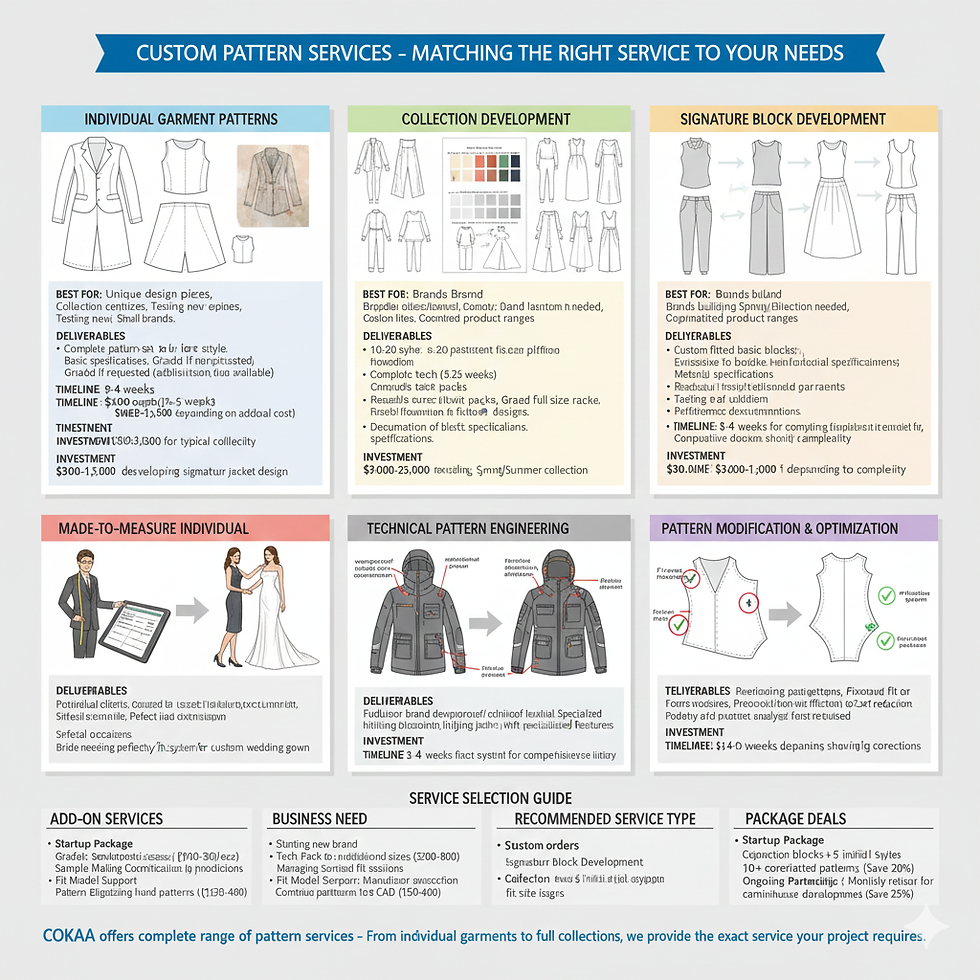
Individual Garment Pattern Development
Best For:
Unique design pieces
Collection centerpiece items
Specialty garments
Test concepts before full line
What You Receive:
Single garment pattern set
Graded if requested
Basic specifications
Sample coordination available
Timeline: 2-4 weeks depending on complexity
Investment: $300-1,500 per garment pattern
Complete Collection Pattern Development
Best For:
Seasonal collections
Brand launches
Coordinated product lines
Fashion brands needing multiple styles
What You Receive:
Multiple coordinated patterns
Consistent fit across collection
Complete technical packages
Size range grading
Production specifications
Timeline: 6-12 weeks for typical collection (10-20 pieces)
Investment: $5,000-25,000 depending on collection size and complexity
Signature Block Development
Best For:
Brands building foundation
Companies needing consistent fit platform
Manufacturers with ongoing production
Designers wanting proprietary blocks
What You Receive:
Custom-fitted basic blocks (bodice, sleeve, skirt, pants)
Engineered to your target customer
Foundation for future designs
Graded across size range
Reusable for multiple styles
Timeline: 4-8 weeks for complete block system
Investment: $2,000-8,000 for comprehensive block library
Made-to-Measure Individual Patterns
Best For:
Individual clients
Custom tailoring businesses
Unique body requirements
Perfect fit priority
What You Receive:
Pattern created to individual measurements
Single-size specific pattern
Fitted to exact specifications
Personal adjustments incorporated
Timeline: 1-3 weeks after measurements received
Investment: $200-800 per individual garment pattern

Technical Pattern Engineering
Best For:
Performance wear
Technical outdoor gear
Specialized functional garments
Products with specific engineering requirements
What You Receive:
Patterns engineered for function
Technical specifications extensive
Testing and refinement included
Material-specific optimization
Performance validation
Timeline: 8-16 weeks for complex technical development
Investment: $3,000-15,000 depending on complexity
Pattern Modification and Optimization
Best For:
Improving existing patterns
Fit problems solving
Production efficiency enhancement
Cost reduction through engineering
What You Receive:
Revised patterns addressing issues
Improved fit or construction
Cost analysis if requested
Comparative documentation
Timeline: 2-4 weeks depending on extent of changes
Investment: $200-1,000 per pattern modified
Part 4: Quality Standards in Custom Pattern Making
Professional patterns meet specific criteria distinguishing them from amateur work.
Accuracy and Precision
Measurement Accuracy: Professional standards require:
±2mm tolerance for critical dimensions
Consistent measurements across all pattern pieces
Verified before delivery
Digital precision in CAD patterns
Geometric Precision: Pattern quality indicators:
Smooth, fair curves (no bumps or flat spots)
Symmetry where intended
Proper grain alignment
Balanced pattern pieces
Corner angles appropriate for construction
Comprehensive Markings
Essential Notations: Professional patterns include:
Grainline arrows clearly marked
Notches for matching points (numbered or coded)
Placement marks for details (pockets, buttons, etc.)
Seam allowances indicated
Pattern piece names and numbers
Size clearly marked
"Cut on fold" indicated where applicable
Directional fabric considerations noted
Construction Information: Patterns should indicate:
Seam types recommended
Ease amounts where relevant
Stretch direction if applicable
Interfacing requirements
Special handling needed
Grading Quality
Proportional Grading: Professional grade maintains:
Proper proportional changes between sizes
Consistent fit intent across range
Appropriate increments (typically 4-5cm between sizes)
Verified measurements for each size
No mathematical errors
Grade Rule Appropriateness: Different body areas grade differently:
Not uniform scaling
Length vs. width grade ratios appropriate
Target demographic considerations
Realistic body proportion changes
Technical Viability
Construction Feasibility: Patterns must be:
Actually sewable (pieces fit together correctly)
Efficient for production
Appropriate for intended construction method
Notched for accurate assembly
Seam allowances suitable for technique
Fabric Compatibility: Pattern engineering considers:
Fabric weight and drape
Stretch properties if knit
Grain line for optimal performance
Bias considerations if present
Lining compatibility if lined
Part 5: Working with a Custom Pattern Making Service
Maximizing value from the relationship requires good communication.
Preparing for Your Pattern Project
Information to Provide:
Design Documentation:
Sketches (multiple views preferred)
Technical flats if available
Reference images showing desired fit
Mood boards for aesthetic context
Fabric swatches or specifications
Fit Information:
Target customer body measurements
Fit preference (close, relaxed, oversized, etc.)
Ease allowances if you have preferences
Problem areas to address
Body type considerations
Technical Requirements:
Size range needed
Production method (cut-and-sew, whole garment, etc.)
Volume expectations
Cost targets if relevant
Timeline requirements
Common Mistakes to Avoid:
Insufficient Information:
Vague fit descriptions ("make it fitted")
No fabric specifications
Unclear size range requirements
Missing critical measurements
No construction method indicated
Unrealistic Expectations:
Expecting immediate turnaround
Assuming first sample will be perfect
Not budgeting for iterations
Underestimating complexity
Expecting lowest price with highest quality
Poor Communication:
Not responding to clarification questions
Changing requirements mid-project
Not providing feedback after fitting
Unclear approval process
No decision-maker identified
Evaluating Pattern Making Services
Questions to Ask:
Experience and Expertise:
How long in business?
What garment categories specialize in?
Do they have experience with your product type?
Can they provide portfolio examples?
Do they understand your target market?
Process and Timeline:
What's the typical process?
How many fitting iterations included?
What's realistic timeline for your project?
What causes delays?
How do they handle revisions?
Deliverables:
What exactly will you receive?
What file formats provided?
Is grading included or additional?
What documentation comes with patterns?
Do they keep archives of your patterns?
Quality Assurance:
How do they verify pattern accuracy?
What happens if there's an error?
Do they test patterns before delivery?
What guarantees do they offer?
How do they handle problems?
Pricing Structure:
How do they price projects?
What's included in base price?
What costs extra (fittings, revisions, grading)?
Payment terms and schedule?
Any ongoing costs?
Red Flags to Watch For
Warning Signs:
Promises unrealistically fast turnaround
Significantly cheaper than market rates
Poor communication or slow responses
No fitting or revision process
Can't provide examples or references
Doesn't ask detailed questions about your needs
Unclear about deliverables
No formal agreement or contract
Unwilling to discuss potential challenges
Overpromises perfection first time
Part 6: Cost Considerations and Pricing
Understanding what influences custom pattern making investment.
Factors Affecting Pattern Making Costs
Garment Complexity: Simple vs. complex dramatically affects price:
Basic t-shirt: $300-600
Simple dress: $500-1,000
Tailored jacket: $1,200-2,500
Technical outerwear: $2,000-4,000
Complexity Factors:
Number of pattern pieces
Curved seaming vs. straight
Details and embellishments
Construction difficulty
Fit precision required
Size Range: More sizes = higher cost:
Single size: Base price
5-size range: +30-50% typically
10+ sizes: +60-100%
Custom size range: Variable
Fitting Iterations: Most services include limited fittings:
First fitting usually included
Second fitting often included
Additional fittings charged separately ($200-500 each)
Extensive revisions may incur fees
Technical Requirements: Specialized needs increase investment:
Performance fabric engineering
Technical specifications extensive
Testing and validation
Specialized construction methods
Regulatory compliance (workwear, PPE)
Documentation Level: More comprehensive specifications cost more:
Basic pattern: Patterns only
Standard: Patterns + basic specs
Complete: Full technical package with construction details, measurement charts, quality standards
Rush Fees: Expedited service commands premium:
Normal timeline: Standard pricing
Rush (50% time reduction): +30-50%
Extreme rush: +50-100%
Typical Pricing Ranges
By Garment Type:
Tops:
Basic tee: $300-600
Fitted blouse: $500-900
Jacket/blazer: $1,200-2,500
Coat: $1,500-3,500
Bottoms:
Basic skirt: $400-800
Pants/trousers: $600-1,200
Jeans (complex): $800-1,500
Dresses:
Simple shift: $600-1,000
Fitted dress: $800-1,500
Evening gown: $1,200-3,000
Specialty:
Swimwear: $800-1,800
Activewear: $700-1,500
Lingerie: $600-1,400
Children's: $300-800
By Service Type:
Per-Garment Custom Patterns: $300-3,000 depending on complexity
Collection Development: $5,000-25,000 for typical 10-20 piece collection
Signature Block Development: $2,000-8,000 for comprehensive system
Pattern Modification: $200-1,000 per pattern
Grading Services: $100-300 per size per garment
Value Assessment
What You're Paying For:
Expertise:
Years of training and experience
Understanding of fit, construction, and design
Problem-solving capabilities
Industry knowledge
Time Investment:
Consultation and planning: 2-4 hours
Pattern drafting: 4-12 hours
Sample coordination: 2-4 hours
Fitting and adjustments: 2-6 hours
Grading: 2-4 hours per size
Documentation: 2-4 hours
Equipment and Overhead:
CAD software ($3,000-10,000 annually)
Professional workspace
Tools and supplies
Insurance and business costs
Quality Assurance:
Verification and checking
Testing when needed
Revision work
Professional standards
Long-Term Value: Quality patterns deliver:
Better-fitting products (higher customer satisfaction)
Reduced returns and complaints
Faster production (clear specifications)
Consistency across production runs
Foundation for future designs
Professional credibility
Part 7: Timeline Expectations
Understanding realistic timeframes prevents frustration.
Typical Project Timelines
Simple Garment (Basic Top/Skirt):
Consultation: 1 week
Pattern draft: 1-2 weeks
Sample and fitting: 1 week
Revisions: 1 week
Total: 4-6 weeks
Moderate Complexity (Dress, Pants, Structured Top):
Consultation: 1 week
Pattern draft: 2-3 weeks
Sample and fitting: 1-2 weeks
Revisions: 1-2 weeks
Grading: 1 week
Total: 6-10 weeks
Complex Garment (Jacket, Coat, Technical Wear):
Consultation: 1-2 weeks
Pattern draft: 3-4 weeks
Sample and fitting: 2 weeks
Revisions (often multiple): 2-4 weeks
Grading: 1-2 weeks
Total: 10-16 weeks
Collection Development:
Initial consultation and planning: 2-3 weeks
Pattern development (staggered): 8-12 weeks
Sample production and fittings: 4-6 weeks
Revisions and finalization: 2-4 weeks
Total: 16-25 weeks (4-6 months)
Factors Affecting Timeline
Your Response Time: Pattern maker can't proceed without:
Approval of initial drafts
Feedback after fittings
Decisions on alternatives
Final approval
Sample Production Time: Not usually pattern maker's control:
Sample maker availability
Fabric procurement
Construction complexity
Shipping if remote
Fitting Logistics: Can extend timeline significantly:
Scheduling fit model or recipient
Multiple stakeholder approvals
Long-distance coordination
Multiple iteration needs
Pattern Maker Workload: Busy seasons affect availability:
Peak times (pre-fashion week)
Current project queue
Team size and capacity
Expediting Options
Rush Service Availability: Many pattern makers offer faster turnaround:
Premium pricing (30-100% upcharge)
Limited to less complex projects
May require scheduling flexibility
Not always available
What Can't Be Rushed: Some aspects have minimum times:
Fabric procurement for samples
Proper fitting evaluation (can't rush judgment)
Drying time if traditional pattern making
Shipping and logistics
Part 8: Digital vs. Traditional Pattern Making
Understanding the methods affects your experience.
Computer-Aided Design (CAD) Pattern Making
Advantages:
Precision:
Exact measurements to fractions of millimeter
Perfect curves and symmetry
Mathematical accuracy in grading
Consistent reproduction
Efficiency:
Faster modifications
Easy grading
Digital storage and archiving
Quick duplication
Flexibility:
Easy to test variations
Simple to make adjustments
Can generate multiple size ranges quickly
Export in various formats
Modern Standard:
Industry standard globally
Production facilities expect digital patterns
Essential for overseas manufacturing
Required for automated cutting
Limitations:
Requires specialized software
Learning curve for complex systems
Technology investment
Can feel less "hands-on"
Traditional Hand-Drafting
Advantages:
Tactile Understanding:
Direct feel for proportions
Traditional craftsmanship
Some pattern makers prefer for creative process
Teaching method for learning
No Technology Dependence:
Works anywhere
No software crashes
No file format issues
Timeless method
Limitations:
Time-consuming modifications
Manual grading labor-intensive
Storage of physical patterns challenging
Digitization needed for production
Human error more likely
Harder to share remotely
COKAA Approach
We use professional CAD pattern making for:
Precision and accuracy
Efficient revisions and grading
Digital file delivery
Industry-standard formats
Long-term archival
While maintaining:
Hands-on understanding of fit and construction
Traditional pattern making expertise
Ability to work from hand-draped designs
Hybrid approach when beneficial
Part 9: Common Challenges and How to Overcome Them
Understanding potential obstacles helps navigate the process smoothly.
Challenge: Miscommunication About Fit
Problem: "Fitted" means different things to different people. Client expects one fit, receives another.
Solution:
Use reference garments (send examples)
Provide specific ease measurements
Show fit examples on similar body types
Be specific about where garment should hit body
Communicate using measurements, not subjective terms
Challenge: Fabric Availability or Changes
Problem: Specified fabric unavailable or client changes fabric after pattern complete, requiring adjustments.
Solution:
Provide fabric swatches early
Verify availability before pattern finalization
Understand that different fabrics may need pattern adjustments
Test with actual production fabric when possible
Inform pattern maker immediately if fabric changes
Challenge: Design Isn't Technically Feasible as Imagined
Problem: Sketch looks great but can't be constructed as drawn, or would be prohibitively expensive.
Solution:
Early technical consultation
Be open to alternatives achieving similar effect
Understand construction limitations
Prioritize which elements are non-negotiable
Trust pattern maker's suggestions
Challenge: Multiple Decision Makers
Problem: Pattern approved by one person, rejected by another. Endless revisions from conflicting feedback.
Solution:
Designate single approval authority
Include all stakeholders in fitting sessions
Get consensus before committing to changes
Document all decisions
Limit revision rounds contractually
Challenge: Budget Constraints
Problem: Project scope exceeds budget, forcing compromises.
Solution:
Discuss budget upfront honestly
Prioritize which garments most critical
Consider phased development
Ask for cost-effective alternatives
Understand where cutting corners has consequences
Challenge: Timeline Pressure
Problem: Production deadline looming, pattern development takes longer than anticipated.
Solution:
Start pattern development early (don't wait until last minute)
Build buffer time into production schedule
Be realistic about iteration needs
Communicate deadline pressures upfront
Be prepared to pay rush fees if necessary
Part 10: Maximizing Your Custom Pattern Investment
Getting the most value from professional pattern services.
Maintain Long-Term Relationship
Benefits of Ongoing Partnership:
Pattern maker learns your aesthetic
Understands your target customer
Knows your quality standards
Faster turnaround on future projects
Better pricing for repeat business
Consistency across collections
Archive and Document Everything
What to Keep:
All pattern files (multiple backups)
Technical specifications
Measurement charts
Sample photos from fittings
Notes on adjustments made
Production feedback
Why It Matters:
Foundation for future designs
Troubleshooting production issues
Training new manufacturers
Protecting your intellectual property
Reference for consistency
Provide Production Feedback
Close the Loop: Inform your pattern maker about:
How patterns performed in production
Any fit issues from customers
Construction challenges encountered
Successful elements to repeat
Changes needed for next season
Benefits:
Continuous improvement
Pattern maker learns from real results
Better patterns in future
Demonstrates professionalism
Strengthens relationship
Understand What You Own
Pattern Ownership: Clarify upfront:
Do you own the patterns? (Usually yes after payment)
Can you use patterns with other manufacturers? (Usually yes)
Does pattern maker keep copies? (Usually yes for their records)
Can pattern maker showcase work? (Discuss confidentiality)
Intellectual Property:
Patterns are typically work-for-hire (you own them)
Get written agreement on ownership
Protect your proprietary designs
Respect pattern maker's process expertise

Conclusion
Custom pattern making services deliver more than just technical drawings—they provide the foundation for your entire garment production, determining fit, quality, consistency, and ultimately customer satisfaction. Professional bespoke pattern development transforms design concepts into production-ready specifications, solving fit challenges, optimizing construction, and ensuring your garments perform as intended.
At COKAA by JR Corporation, our custom pattern making services combine 20 years of expertise with modern technology and deep understanding of garment engineering. We create made-to-measure patterns that translate your design vision into perfectly fitting, production-ready garments, whether you're launching a fashion brand, developing a signature collection, or creating specialized products requiring expert pattern development.
Successful custom pattern making requires clear communication, realistic expectations, appropriate investment, and partnership with experienced professionals who understand not just pattern drafting but comprehensive garment engineering. Brands investing in quality custom pattern services build foundations for superior products, satisfied customers, and long-term business success in competitive fashion markets.
Ready to develop custom patterns for your fashion brand? Contact COKAA for professional bespoke pattern making services tailored to your exact requirements.
Frequently Asked Questions
How long does custom pattern making take?
Timeline depends on complexity: simple garments 4-6 weeks, moderate complexity 6-10 weeks, complex items 10-16 weeks, full collections 4-6 months. Factors include design complexity, fitting iterations needed, grading requirements, and your response time to approvals and feedback.
What information do I need to provide for custom patterns?
Essential information includes: design sketches/technical flats, target body measurements or customer demographics, fabric specifications, size range needed, fit preferences, production method, timeline requirements, and budget. More complete information enables better, faster pattern development.
How much does custom pattern making cost?
Pricing varies by complexity: basic garments $300-600, moderate complexity $500-1,500, complex garments $1,200-4,000+. Collection development $5,000-25,000. Factors affecting cost include garment complexity, size range, fitting iterations, technical requirements, documentation level, and timeline.
What's the difference between modifying existing patterns vs. custom patterns?
Modified patterns adapt existing blocks to new designs—faster and less expensive but limited by original block. Custom patterns are created specifically for your design—optimized for exact fit, fabric, and construction requirements. Custom patterns deliver superior results for unique designs or precise fit needs.
Do I own the patterns after paying for custom pattern making?
Typically yes—custom pattern making is usually work-for-hire, meaning you own the patterns after payment. However, get written agreement clarifying ownership, usage rights, pattern maker's archival rights, and confidentiality. Most pattern makers keep copies for their records but you control usage.
Can custom patterns be used with any manufacturer?
Yes, professional custom patterns are production-ready and can be used with any manufacturer capable of your garment type. Digital pattern files in industry-standard formats (DXF, AAMA, etc.) ensure compatibility with most production facilities globally, giving you manufacturing flexibility.


Comments